Saturday, June 30, 2012

Lady Almina and the Real Downton Abbey by Fiona, Countess of Carnarvon

Despite having watched (and enjoyed) the first season of Downton Abbey, when I saw a book about "the real Downton Abbey," I wasn't even remotely tempted to pick it up.

What changed my mind? I was really ambitious with signing up for reading challenges this year and my reading and blogging were derailed for most of winter and spring. My mother was in and out of the hospital for the better part of three months (she's fine), then I was sick (still tired, but in the process of bouncing back) and I found myself nearly halfway through the year with only three book reviews (one posted, two waiting to be posted) under my belt and way behind on my reading challenges. (Seriously, look at my challenge progress and laugh. You're more than welcome.) Anyway, so when I saw that Impressions in Ink had done a review of the the book for the War Through the Generations reading challenge, I grabbed a copy from the library immediately...and promptly ignored it until a couple of days before the book was due.

I've finally finished it and I can't believe it took me so long to finally read it. Since the book is written about Almina, Countess of Carnarvon and her home, Highclere Castle (better known as television's Downton Abbey) by Fiona, the current Countess of Carnarvon, I assumed it would be a fluff piece attempting to cash in on the popularity of Downton Abbey.

Wrong. It was extremely well-written and well-researched. There are three distinct parts to the book. In the first part, pre-World War I, focuses on Almina's background as the illegitimate daughter of the extremely wealthy and influential Alfred de Rothschild; her marriage to the Fifth Earl of Carnarvon; and her initial life as an extremely indulged and well-connected member of the nobility. The second part focuses on the events of World War I, including how it affected Highclere Castle and the activities of the family during World War I, including Almina's efforts to establish a hospital at Highclere. Finally, the last part of the book covers life after the war up to the death of the Almina's husband.

In the early part of the book, I was impressed. Almina and her family lived fascinating lives and the current Countess of Carnarvon did a wonderful job of making use of the family records available to her and adding insights about their activities. It was particularly interesting to see how much and how little things had changed at Highclere Castle. However, it was the second and third parts that truly impressed me. Based on the title, I had expected the book to focus only on Highclere Castle and the hospital that Almina ran during World War I. That alone would have been fascinating, since she didn't stop at just establishing a hospital (something many other society ladies were doing during World War I). She tried to establish the best hospital, both by attracting the best staff and purchasing the best equipment and by, as the author put it, treating the soldiers at Highclere Hospital as house guests in addition to patients. The author also covers the actual events of World War I, using both the experiences of the soldiers turned Highclere patients (her description of David Campbell's experiences at Gallipoli was particularly harrowing) and the experiences of the Carnarvon family (Aubrey Herbert, her husband's younger half-brother, played an important diplomatic role). This part is clearly well-researched and the descriptions are extremely powerful.

The final part of the book focuses mainly on her husband's role in the discovery of King Tut's tomb with Howard Carter (he had backed Carter financially for about fifteen years). Unfortunately, the press frenzy strained not only Carnarvon and Carter, but also their friendship. It also led to Carnarvon's death at 56 shortly before the discovery of the sarcophagus of Tutankhamun.

The writing style is wonderful. Even in the earlier, happier days, there's quite a bit of foreshadowing about the future. I've noticed that this ominous feeling is frequently there when I'm reading historical accounts leading up to particularly tragic events, but it was definitely well-done in this story. It helped to illustrate exactly how World War I led to a lost generation, mainly by mentioning the fates of Highclere men and acquaintances of the Carnarvon family who had joined the war effort. This is definitely not a fluff book and I would absolutely recommend it to anyone interested in private Egyptian archeology, World War I, or life of English nobility during the first part of the twentieth century.

This book counts word the Support Your Local Library, War Through the Generations, and Non-Fiction, Non-Memoir challenges.

Monday, June 4, 2012

The Book of Madness and Cures by Regina O'Melveny

We'd been traveling for eight months, and all my inquiries had led nowhere. Though I now possessed his glasses, his shoes, and the description of a man unravelling in Edenburg. Perhaps I was the one unraveling?
-The Book of Madness and Cures

At the beginning of the novel, Gabriella is comfortable (if not happy) with her life as a woman doctor in late sixteenth-century Venice. Her father has been gone for ten years and her relationship with her mother is strained, though it seems that she could have continued this slightly unhappy if comfortable existence indefinitely. Two events force her into action. First, she received a letter from her father saying that he doesn't intend to return to Venice. Second, the Guild of Physicians informs her that they no longer support her membership without her father. She sets out to find her father by retracing his steps across Europe.

Even though Gabriella is thirty when the novel begins and is set in her life and career, it's still a coming of age story. In the beginning, Gabriella worships her father and has a strained relationship with her mother. She views Lorenzo and Olmina, the married couple who accompany her on her journey, as servants despite the fact that they had been with her since her birth and Olmina nursed Gabriella after her own daughter was stillborn. Gabriella has also given up on marriage following the death of her lover twelve years earlier. As the story unfolds and Gabriella learns more about her father and his apparent reasons for departing, she's forced to reconsider her relationship with both her mother and her father. She begins to see her father a regular, if flawed, person and as her view of her father changes, her view of her mother and her mothers' motivations also evolves. After a few of traveling with Lorenzo and Olmina, she also reexamines her relationship with them and their motivation for accompanying her on a difficult journey. And, of course, because it's such a common plot, she also encounters potential love interests who help to change her view on marriage and her future in that regard. Personally, the last element felt a little tacked on and obligatory, if not downright cliche. 

Initially, I had trouble getting into the story for some reason, but it was worth it. Watching Gabriella's growth was interesting, as was reading about her time in various cities. Throughout the book, there are excerpts from The Book of Diseases, a collection of illnesses that she is helping her father to finish. The excerpts gave insight not only into Gabriella's feelings, but also of the medicine of the era.

That said, as with a lot of similar novels, there was one major shortcoming. Gabriella and most other characters seemed a little too progressive. Very few of the people she encountered had a problem with the idea of a woman doctor or of a woman pretending to be a man (which happened a couple of times). Since Gabriella is following the travels of her father and staying with his acquaintances, this makes sense in a lot of cases because a man who trained his daughter as a doctor would presumably correspond with similarly progressive people. It makes less sense for people she randomly encounters. The views of Gabriella herself wouldn't be out of place today. I'm not an expert on the attitudes and beliefs of sixteenth century Venice, so it's entirely possible that Gabriella's attitude was reflective of the time. Also, if Gabriella has been a traditional woman, there wouldn't have been much of a novel since she would have just married and accepted her father's absence. Furthermore, I don't think the majority of readers would have enjoyed Gabriella discussing how she completely agreed with her city's decision to force Jews to live in ghettos. I also noticed that Gabriella tended to encounter fewer problems from other people as her journey progressed.

Overall, I really enjoyed the novel and would recommend it to anyone who enjoyed that time period or reading about older medical treatment.

This book counts toward the Support Your Local Library Challenge and 2012 Debut Adult Fiction Author Challenge

Thursday, March 1, 2012

A Year Without "Made in China" by Sara Bongiorni

Cross-posted to my other blog, A Life Less Cruel.

The title of A Year Without "Made in China" is pretty self-explanatory. It's a chronicle of Sara Bongiorni's attempt to live without products made in China.I can't remember where I heard about this book, but when I found out that the library had a copy of it, I was fairly excited to read it. I wanted to like it. I absolutely love reading about someone who has drawn an ethical or moral line in the sand and their experiences with it. A couple of examples off the top of my head are A Plastic-free Life and The Zero Waste Home. Unfortunately, I didn't like it.

The opening paragraphs give a pretty good idea of the tone of the entire book.

We kick China out of the house on a dark Monday, two days after Christmas, while the children are asleep upstairs. I don't mean the country, of course, but pieces of plastic, cotton, and metal stamped with the words Made in China. We keep the bits of China that we already have but we stop bringing in any more.

The eviction is no fault of China's. It has coated our lives with a cheerful veneer of cheap toys, gadgets, and shoes. Sometimes I worry about lost American jobs or nasty reports of human rights abuses, but price has trumped virtue at our house. We couldn't resist what China was selling. But on this dark afternoon, a creeping unease washes over me as I sit on the sofa and survey the gloomy wreckage of the holiday. It seems impossible to have missed it before, yet it isn't until now that i notice an irrefutable fact. China is taking over the place.


Bongiorni primarily viewed as an experiment or a game. In fact, she sold it to her husband as a reverse scavenger hunt and put a lot of focus into creating rules (such as allowing gifts that were made in China). Later, she used those rules to technically adhere to the boycott while getting what she needed (like encouraging her husband's sister to buy an inflatable pool as a birthday gift for her husband when she is unable to find an inflatable pool that wasn't made in China). A few times, she made references to globalization and the fact that so many things were made in China that we were fast approaching the point that we no longer had a choice in whether to buy Chinese goods. In fact, in some areas, we don't have a choice now. Early in the book, when she was shopping for a new lamp, she found out that light switches are no longer made in the US. The subject of toys comes up frequently, since she has younger children, and she was only able to find a handful of toys (mainly Legos) that weren't made in China.

Unfortunately, aside from a few "China is too big" references in the book, she never really gave a well-reasoned argument for boycotting China, despite the fact that it's pretty easy to make a strong argument. China has a horrible record of human rights violations in factories (Foxconn, anyone?) and they're very lax on environmental issues. There's also the animal cruelty issues. In fact, I avoid fake fur and fake sheepskin (for instance, Ugg knockoffs) due to the fact that both are often made from animal fur (dog in the case of fake fur and raccoon doss for the Uggs and the slaughter process is poorly regulated and incredibly inhumane. (I'm not providing links because I don't feel like digging through the stories, but if you want to research the issue on your own, be warned that it's very disturbing.) Bongiorni doesn't really consider any of that, though, and the best explanation she gives is when she tells her son that it wasn't that they don't like China, but China was too big and they wanted to give someone else a chance to make things. Not surprisingly, given her reasons for the boycott, she had no problem with buying products made in countries with equally horrible working conditions as long as the products weren't made in China.

I was also disappointed with how she handled the issue with her family. She spends a lot of time in what strikes me as a power struggle with her husband, clinging to the idea that they must boycott China at any costs. Early on in the book, her husband loses his sunglasses and, despite the fact that he was supposed to wear sunglasses due to a growth on his eye, she pushes him to do without and, later, comes up with ridiculous and ineffective solutions to keep him from buying new sunglasses since American or Italian sunglasses were too expensive and the cheaper options were all made in China. This continues throughout the book and, frankly, it doesn't make either of them look good.

The way she handled it with her children was also a problem for me. She doesn't really make an attempt to change their values or really give them reasons to boycott China (though her daughter was probably too young to understand anyway). This means that her son develops what seems to be a hatred of the Chinese, saying at one point that he was glad people were hungry because they were bad. Bongiorni spends a lot of time worrying that the experiment had made her children xenophobic. I couldn't understand why she just didn't say "We like the people of China, but the people that make things in China make the people work in bad conditions, so we don't want to support them" or some variation of that. I can't find remember her son's exact age, but I remember understanding that sweatshops were a bad thing and that buying products made there was bad even when I was pretty young. I also found it interesting that, while she was pretty quick to deny things her husband needed (sunglasses and, arguably, flip flops for the beach), she decided that her son was suffering, yes, suffering for not being able to buy Chinese made toys.

Finally, I was annoyed at her lack of balance. One thing I struggle with is balancing various concerns, like buying a plastic free product vs a cruelty free product or choosing organic produce with plastic packaging (it happens more than you'd think) or plastic free conventional produce. Bongiorni, however, placed "not made in China" above all else. When she had mice, she had to choose between a Chinese humane trap or an American snap trap. After completely avoiding the issue and letting mice run rampant in her house, she chose the American snap trap. If she were boycotting for human rights reasons, I could understand her logic. But since it was just "China is too big," then why buy snap traps and kill mice when you'd prefer humane traps?

The writing style was that of a good blogger, if that. In fact, I think the book might have been better if she had kept a blog first and then condensed it into a book. That seems to be a very effective method in writing books like this, based on what I've seen in other books. I read the book in an afternoon and spent the entire time hoping it would magically improve. It didn't.

On the plus side, I suppose I learned a couple of things. Or, more accurately, it confirmed what I already knew or should have realized with a little thought. Chinese-made products dominate the market, especially in certain areas, and it's hard to avoid them. It's also positive to live without them, though it doesn't seem to be a long term solution to the problem. It was a good reminder to be more thoughtful about the products I buy, though, and I think that country of origin will be a larger factor in my choices. It's also encouraged me to read up on globalization a bit more.

This book counts toward the Support Your Local Library Reading Challenge.

Tuesday, January 31, 2012

Winter's Respite Wrap-Up

Winter's Respite Read-a-thon
Photobucket

I'm a little behind on this, but here's my wrap-up post for the Winter's Respite Read-a-Thon hosted by The True Book Addict. My goals were to finish the three books I was currently reading (A Personal Matter, A Charmed Death, and A Mid-Summer Night's Dream and to start 1Q84. I accomplished none of those goals. I did, however, read The Second Duchess.

All in all, I'm a little disappointed that I wasn't more on the ball with the challenge, but last week was a little hectic and so my entire schedule was thrown off. That said, I'm glad I did the read-a-thon and look forward to doing more in the future. Next time, I definitely want to set aside time to read every day, as opposed to "I'll read when I read." I'd also like to pay more attention to mini-challenges and Twitter, since I was really looking forward to the social interaction aspect of the challenge.

Tuesday, January 24, 2012

Winter's Respite Read-a-Thon 2012

Today kicks off the 2012 Winter's Respite Read-a-Thon hosted by The True Book Addict. It's also my first Read-a-Thon ever, so I'm pretty excited.

Here's my list for the challenge:

A Personal Matter by Kenzaburō Ōe

A Charmed Death by Madelyn Alt

A Mid-Summer Night's Dream by William Shakespeare

1Q84 by Haruki Murakami

I've already started the first three and I'm reading Shakespeare for Reading Shakespeare . I'm already one act behind and I participated in the discussion yet. I haven't started 1Q84 yet and I doubt I'll finish it by the time the Read-a-Thon's over, but I'd like to at least get a head start on it. I also need to start Gone with the Wind for the Gone with the Wind Read-a-Long.

I'm not sure how far I'll get, but I'm definitely looking forward to trying!

Friday, January 13, 2012

2012 Read Alongs/Read-a-thons

I thought I would try keeping track of the read alongs I've signed up for this year.

A Midsummer Night's Dream,
Photobucket
Runs: January 15, 2012 - January 30, 2012

Specific Works: A Midsummer Night's Dream

Specific Rules: None

Status: In Progress


Winter's Respite Read-a-thon
Photobucket
Runs: January 23, 2012 - January 29, 2012

Specific Works: None

Specific Rules: No

Status: Completed

The Second Duchess
The Second Duchess by Elizabeth Loupas


Gone with the Wind Read-A-Long
Photobucket
Runs: January 16, 2012 - Unknown

Specific Works: Gone with the Wind

Specific Rules: No

Status: In Progress

Tuesday, January 10, 2012

2012 Reading Challenges

I was a little disappointed with the results of my 2011 reading challenges, both in the number of challenges and the amount of books I read for each challenge. (Although I just noticed that a couple of them don't end until early 2012, so I can at least get one non-Tanizaki book in for the Japanese literature challenge.) This year, I'm being a little more aggressive by signing up for more. I met the goals for all the challenges I signed up for in 2011 (all three of them), so why not aim higher this year?

So, here's my list of 2012 Reading Challenges:

Banned Books Challenge
Photobucket

Runs: January 1, 2012 - December 1, 2012

Rules: Read banned or challenged books. No re-reads.

Level: Starting at Level 1, Read 12 Banned/Challenged books


A Tale of Redwall
Photobucket

Runs: January 1, 2012 - Perpetuity

Rules: Read all the books in the Redwall series


Reading Challenge Addict Challenge
Reading Challenge Addict


Runs: January 1, 2012 - December 31, 2012

Rules Enter and complete reading challenges.
Level: Starting goal is Easy as Pie, 1-5 challenges


2012 Young Adult Reading Challenge
Photobucket


Runs: January 1, 2012 - December 31, 2012

Rules: Read Young Adult Novels

Level: Starting goal is The Mini YA Reading Challenge – Read 12 Young Adult novels.


2012 Support Your Local Library Challenge
Photobucket

Runs: January 1, 2012 - December 31, 2012

Rules: Read library books

Level: Starting goal is Level 1 - Read 12 library books, but I'm pretty sure I'll go much higher
1. My Year Without Made in China by Sara Bongiorno
2. The Book of Madness and Cures by Regina O'Melveny
3. Lady Almina and the Real Downton Abbey by Fiona, Countess of Carnarvon


2012 Adult Fiction Debut Challenge
Photobucket

Runs: January 1, 2012 - December 31, 2012

Rules: Read debut books by adult authors

Level Starting goal is Bronze: 1-5 Reviews, Interviews and/or Guest Posts
1. The Book of Madness and Cures by Regina O'Melveny

2012 Sci-Fi Challenge
Photobucket

Runs: January 1, 2012 - December 31, 2012

Rules: Read one sci fi book per month.


War Through the Generations - World War I
Photobucket

Runs: January 1, 2012 - December 31, 2012

Rules: Read fiction, nonfiction, graphic novels, etc. with the WWI as the primary or secondary theme. Books can take place before, during, or after the war, so long as the conflicts that led to the war or the war itself are important to the story. Books from other challenges count so long as they meet the above criteria.

Goal: Wade: Read 4-10 books in any genre with WWI as a primary or secondary theme.
1. Lady Almina and the Real Downton Abbey by Fiona, Countess of Carnarvon


Non-Fiction Non-Memoir Reading Challenge
Photobucket

Runs: January 1, 2012 - December 31, 2012

Rules: Read non-fiction, non-memoir books.

Goal: Bachelor's Degree - 15 nonfiction books
1. Lady Almina and the Real Downton Abbey by Fiona, Countess of Carnarvon


2012 Science Fiction Reader Challenge
Photobucket

Runs: January 1, 2012 - December 31, 2012

Rules: Read sci-fi books from twelve selected categories


2014 Winter Olympics Reading Challenge
Photobucket
Runs: March 1, 2010 - Feb 6, 2014

Rules: Read a book featuring a country that got a Medal in the 2010 Winter Olympics.

Goal Level 1 (Gold): Read a book from every country that won a medal.

Northern Africa
Photobucket
Runs: January 1, 2012 - December 1, 2012

Rules Read eleven books either set in this region or written by authors from this region in 2012.


2012 TBR PILE Reading Challenge
Photobucket
Runs: January 1, 2012 - December 31, 2012

Rules: Read from your To Be Read pile.

Goal: Starting with 1-10 - A Firm Handshake

Tea and Books Reading Challenge
Photobucket
Runs: January 1, 2012 - December 31, 2012

Rules: Read books with more than 700 pages.

Goal: Chamomile Lover - 2 books


The Dystopia 2012 Challenge
Photobucket
Runs: January 1, 2012 - December 31, 2012

Rules: Read dystopian books.

Goal:Starting with Asocial– 5 books


Off the Shelf 2012
Photobucket
Runs: January 1, 2012 - December 31, 2012

Rules: Read books acquired before 2012

Goal: Starting with Trying - 15 books read


Immigrant Stories Challenge
Photobucket
Runs: January 1, 2012 - December 31, 2012

Rules: Books read must include an immigrant story. Any country counts.

Goal: Starting with Just off the boat: 1-3 books


Stephanie Plum Reading Challenge
Photobucket
Runs: January 1, 2012 - Perpetuity

Rules: Read the Stephanie Plum series by Janet Evanovich


Fairy Tales Retold Challenge
Photobucket
Runs: January 1, 2012 - December 31, 2012

Rules: Read original fairy tales or retellings.

Goal: Princess - 12 books


2012 Mammoth Book Challenge
Photobucket
Runs: January 1, 2012 - December 31, 2012

Rules: Read books with 450 or more pages.

Goal: Starting with Level 2 - Read 4 mammoth-sized books


2012 Witches and Witchcraft Challenge
Photobucket
Runs: January 1, 2012 - December 31, 2012

Rules: Any full length book that includes a witch as a main character or major witchcraft elements counts. They may be fiction or non-fiction.

Goal: Initiate - 1-5 Witchy Books


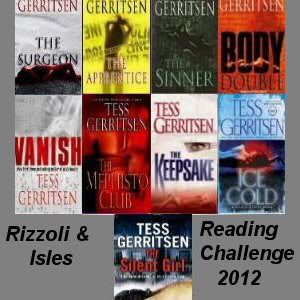
Rizzoli and Isles Reading Challenge
Photobucket

Runs: January 1, 2012 - December 31, 2012

Rules: Read the Rizzoli and Isles series by Tess Gerritsen

Goal: Reread the three books of the series I've already read and read the other six, so nine books total.


2012 Nordic Challenge
Photobucket
Runs: January 1, 2012 - December 31, 2012

Rules Read books by an author born in a Nordic country (Denmark, Finland, Iceland, Norway and/or Sweden) or set in Nordic countries


Agatha Christie Reading Challenge
Photobucket
Runs: January 1,2012 – December 31,2012

Rules: Read works by Agatha Christie in order of publication

Venice in February Reading Challenge
Photobucket
Runs: February 1, 2012 - February 28, 2012

Rules: Read books set in/about Venice.