Monday, April 1, 2013

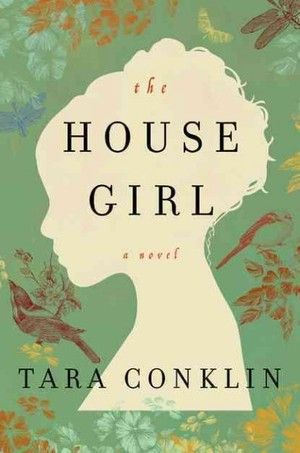
The House Girl by Tara Conklin


The House Girl was on the featured shelves at the front of the library and I picked it up based on both the cover and the title.  I was intrigued by the premise and I wanted to read something for Black History Month.  Even though I finished it about a month late, I'm still glad I read it.

The plot focused on the parallel lives of two very different women: Lina, a young lawyer at a white shoe law firm and Josephine, a house slave in Virginia.  Their stories intersect when a major client of Lina's law firm wants to start a reparations suit on behalf of the descendants of slaves (he estimates an unjust enrichment of nearly 7 trillion dollars based on slave labor) and needs a compelling lead plaintiff.  Lina's father, an artist just beginning to achieve commercial success and preparing for a show featuring images of Lina's dead mother, Grace, brings up a recent controversy regarding the authorship of the paintings of Lu Ann Bell, an iconic southern artist.  Scholars have started to question whether the paintings were made by Lu Ann or by her house slave, Josephine Bell.  Lina decides that a descendant of Josephine would be the perfect lead plaintiff for her case, but there are no records of Josephine after Lu Ann's death in 1852.  Lina begins her search and the reader learns more about Josephine's life and, of course, Lina's own life.

Overall, I enjoyed the book.  It was well-written and the structure was interesting.  It's divided into three sections, each with a different set of narrators.  Part one features Lina and Josephine; part two uses Lina, Josephine, and Dorthea, the sister of a well-known abolitionist and suffragette; and part three goes back to Lina, Josephine, and Caleb, a man who plays a small but significant part of the story.  Lina's story, obviously, is told from her own point of view.  Josephine's story, however, is told not only from her point of view, but also through articles and letters.  Overall, the book's structure reminds of A.S. Bryant's Possession.

Unsurprisingly, a book involving this subject matter is going to raise some interesting issues. First and foremost, not only was the book written by a white woman, but Lina, another white woman, was the driving force behind the story.  That's obviously problematic when the subject of a book is about slavery and a black woman's voice being silenced by a white woman.  Most of the other well-developed characters were white, including Dorthea, Caleb, and Jasper, a possible descendant of Josephine and a potential lead plaintiff (and potential love interest for Lina).  Dresser, the client behind the lawsuit, is black, but although he has strong personal convictions about suit, he's also only doing it because it's politically expedient.  Consider one of his quotes:
We would not be the world's superpower today if we had not had two hundred and fifty years of free, limitless labor on which to build our economy... What were their names, Dan?  They were our founding fathers and mothers just as much as the bewigged white men who laid the whip against their backs.  Isn't it time this country made the effort to remember them?

Then this one:

"I've gotten confidential confirmation that, after we file the suit, the government will issue a formal apology for slavery... We'll pull the government claim and then the feds will ut some pressure on our corporate defendants to settle... It's a nice distraction, you know, atone for the sins of the past, maybe divert attention away from the perceived sins of the present.  But it's the deep pockets we're concerned with here.  The government gets to look like the good guy, and we get some real weight behind us."

Since the book is set in 2004, one of the major "perceived sins of the present"  was, of course, Abu Ghraib.  So the only real person of color in the contemporary part of the story is not only not very fleshed out, but also at least a little amoral regarding the subject.  It also strikes me as a bit problematic that the potential face of the effects of slavery today was not only white (technically about 1/64th black), but had no idea that he had a black ancestor or that said ancestor was a slave.

As a white woman, I don't feel comfortable going too far into the racial issues, but I am comfortable discussing the gender issues.  Specifically, as with the race issue, this is also a story of women, but again, it's driven forward by men.  Not only that, but it seems to pit woman against woman a lot.  First, Lina is threatened by Meridith.  Here's the description of her:
  
[T]he six-foot blond litigation associate rumored to be dating a Yankees outfielder... Meridith sat ramrod straight in meetings, she spoke articulately, rationally, with apparent  interest [about a variety of subjects].  Lina saw her as a nemesis of sorts, an otherworldly being who provoked Lina's competitive streak as well as her annoyance.  (Meridith frequently forgot Lina's name.)
 Second, the issue of authorship of the paintings is presented as a zero-sum game.  Lu Ann Bell had been embraced "by modern feminists  as civil rights activists as a woman who, due to the constraints of the society in which she lived, expressed her beliefs in the only way she could: through her art."  It's important to remember that Lu Ann never took credit for Josephine's work.  In fact, since apparently neither Lu Ann nor Josephine signed their work, the authorship was only assumed.  Second, Lu Ann was an artist, but lacked Josephine's talent.  Regardless of her natural ability, though, her art was still an outlet.  Despite all of this, though, it's presented as an either/or situation.  If Josephine's authorship is acknowledge, then, as the archivist at former home of Lu Ann (and Josephine) said, Lu Ann (or at least the idea of her) will be "lost."

In both examples, there's the clear idea that the greatest threat to a woman is another woman.  In Lina's case, there's no particular reason given for her to see Meridith as a bigger threat than any other first year associate, but for some reason, she does.  In the case of Josephine and Lu Ann, there's the idea that only one of them can be given a voice and the other has to sink into the same voicelessness that countless other women have suffered.  It doesn't matter that both women have a story to tell and that story would, in turn, help provide a voice for other women in the same position.  Apparently, a woman has to earn the right to be heard and only the great artist gets a voice.  The other woman, the one who made mediocre art, sinks back into obscurity.

Finally, there's the issue of Josephine's child.  Her child's father was white.  More accurately, her  child's father was Lu Ann's husband, "Mister," and the child was the product of rape.  While this was examined more specifically in some of the information I came across while looking for some background information and while Conklin did explore this issue a bit and while she did examine the strain this placed on the relationship between Lu Ann and Josephine, the full horror of it wasn't explored.  Oddly enough, I feel that The Office did a better job addressing the problems of that issue.

I want to emphasize that I absolutely enjoyed the book and I think Conklin did a great job of exploring difficult subject matter.  In fact, the very fact that these issues occurred to me proves that Conklin wrote a thought-provoking book.  I think that most of my criticisms are more a product of society at large and even the greatest novel dealing with this subject matter is going to still have its shortcomings when it comes to examining issues of race and gender.  In fact, I feel like I'm completely ignoring some other important parts of the book, such as Lina's feelings toward her dead mother and how her father's art exhibition of portraits of her mother affects her not because they don't merit examination, but because there's so much to discuss.   Furthermore, I think that a lot of the more problematic aspects of the book are the most realistic, such as murky motivations for filing the suit, glossing over the implications of a white man being descended from a slave, and the adversarial relationship between women.  That said, I can't recommend this book enough.  Not only did it keep me engaged until the very end, once it was over, it made me think. 

Wednesday, January 23, 2013

Reflections on 2012 and Thoughts on 2013

It's a little late to do this and I've debated on whether 2012 even merits a wrap-up post, but I finally decided that I might as well bite the bullet, get some closure, stop feeling guilty, and look toward the future. 

In 2012, I signed up for a lot of reading challenges  and didn't complete that many.  I believe I completed four, though I didn't make posts on all the books I actually read.  A couple of challenges are either perpetual or haven't ended yet, so there's still a chance to make it through.  I can't help but feel guilty for not at least making a better effort to complete and participate in the various challenges, since I was very excited about both reading the relevant books and seeing what other bloggers read and posted.  

Without going into too much detail, 2012 was a fairly trying year.  Both my parents had some relatively minor health problems that resulted in each of them spending some time in the hospital and then going to a rehabilitation unit to regain strength.  I also had some health problems in 2012, though nothing significant.  Everyone is much better now and hopefully things should get back to normal. 

External factors played a huge role in reading, posting, and participating, but there were several internal factors as well.  In fact, those internal factors probably affected my blogging more than the external, especially after I felt like I was falling behind.  I'm a perfectionist.  And a procrastinator.  And I majored in English in undergrad.  So even though I spent a lot of time writing about books, I'm still having trouble with how to approach book blogging, specifically what to post and how often.

To make a long story short, I've decided to try to do short reviews of everything I read on Goodreads then make a blog post when I feel like I have more to say.  I also plan to interact more with other bloggers and try to go outside my comfort zone in choosing books.  To that end, I still plan to do challenges, read-a-thons, and read alongs.  This year, though, I plan to sign up for them throughout the year, after I've read at least one appropriate book.  I already have my eye on a few, so I have a feeling I'll end up signing up for quite a few year, too, but hopefully I'll actually manage to complete more this year.

Oh, and I'll hopefully make my 2013 wrap up post before January is nearly over.

Wednesday, January 2, 2013

Death of a Schoolgirl by Joanna Campbell Slan


Death of a Schoolgirl takes place after Jane Eyre, but you may have to squint a bit to recognize the characters.  Mr. Rochester is a loving husband and new father who is slowly coming to terms with his injuries and his role in life.  Jane is a devoted wife and mother who is trying to grow into her new life as  a gentleman's wife and who also happens to dash off for a bit of undercover work to solve a murder.  Surprisingly, it works...as long as the reader doesn't examine certain aspects of the plot too closely.

The story begins about a year after the end of Jane Eyre.  Mr. Rochester and Jane are living at Ferndean Manor, a hunting lodge built by the Rochester family.  Mr. Rochester is recovering from the injuries sustained in the fire that destroyed Thornfield Hall and Jane is recovering from the birth of their son, Ned.  After months of confusing letters from Adèle Varens, Mr. Rochester's ward, they finally receive a letter that includes a hidden request for help as well as a threat made against her.  With Mr. Rochester temporarily unable to travel due to problems with his eye, Jane makes her way to London where she will stay with the wife of Mr. Rochester's best friend, Lucy Brayton, and find out exactly what's happening at Adèle's school.  When she arrives at the school, though, she finds the police removing a body from the school and she is mistaken for the new German teacher.  In order to learn the truth, Jane poses as a German teacher and tries to unravel the mystery behind the death of one of Adèle's classmates.  

As a cozy mystery, it easily exceeded my expectation.  As a story based on Jane Eyre, my opinion is a little more complicated.  Immediately after reading it, I was impressed.  I enjoyed the writing style and it was interesting to see what Mr. Rochester and Jane were doing.  The book also introduced some fascinating new characters and revisited some older characters.   Lucy Brayton is a fascinating character (and one that I think we'll see more of, since the next book in the series is also set in London) and I enjoyed seeing Adèle's new life.  

Death of a Schoolgirl also touched on a few of the themes of Jane Eyre, especially class and the issue of governesses and class mobility.  Several of the teachers at the school are former governesses and have strong feelings on their amorphous role in society.  Unsurprisingly, there was a certain amount of resentment aimed at their employers due to their treatment.  In the words of one of Jane's coworkers:

Our world is larger than theirs...and so we cause the parents grave discomfort.  We are what they shun, and also what they aspire to be: educated.  Thus, we are relegated to the margins of their society.  We are the outcasts, the pariahs--women who do not trade solely on their looks, but who aspire to a higher calling, because we possess cultivated minds.

While women like Miss Jones and Miss Millers, Jane's colleagues, are trapped in a difficult role with very little hope of improvement, there are a few issues of class mobility as well.  Obviously, Jane is an example, going from a penniless governess to the wife of a gentleman.  There are also negative examples.  Maude Thurston, the superintendent of the Alderton House School for Girls, was once a member of high society, but her husband gambled away his fortune and then committed suicide.  Mrs. Thurston took the position at the school in order to pay the bills her husband left behind.  Likewise, Lady Kingston, the founder of Alderton House School, was very wealthy, but she lost her fortune due to her son's drinking, gambling, and womanizing.  

The one problem I had was Mr. Rochester.  Although it's been a while since I read Jane Eyre (high school, perhaps?), I do remember that, while Mr. Rochester may have been considered a romantic hero, I also remember him as a fairly horrible person..  I think that reading Wide Sargasso Sea played a role in my opinion of him, but I also just remember having a negative reaction to certain parts of the book.  I really need to reread <i>Jane Eyre</i> to see how I'll react to it now.  Going from memory, though, Rochester was a wonderful Byronic hero and while the difficulties that they faced in their relationship made for an interesting novel, I'm highly skeptical of how Mr. Rochester will fair in The Jane Eyre Chronicles.  In the first book, he was quite content with his new wife and son despite the difficulties he faced after his injuries.  He seemed to be improving after his injuries and was making plans to rebuild Thorton Hall.  He also show up conveniently to save Jane toward the end of the novel.  It worked for this novel, but if author plans to make Mr. Rochester a major character in this series, she's going to face an uphill battle.  Is it possible to maintain the qualities that made him the hero of Jane Eyre while still turning him into a character that will also be an acceptable spouse for a Jane Eyre with fairly modern sensibilities.  It's also clear that the author is taking the Jane Eyre view toward Bertha, Mr. Rochester's first wife, specifically that Bertha was in the wrong, Mr. Rochester was a victim, and it was utterly tragic for him to have to forgo love in order to marry for money, as ordered by his father.  It's a relatively minor thing (unless her story figures more strongly into later novels and that wouldn't surprise me at all), but pitting two women against each other over a man with one woman ending up completely vilified while the man (often the only one with any real power in these situations) is somehow portrayed as a victim rubs me the wrong way.  It's all well and good to look at books like Jane Eyre and remind myself that the book was published in the 1800's and things are so much different now, but that treatment obviously won't hold up in a book published in 2012.  

Misgivings aside, I enjoyed Death of a Schoolgirl and I'm looking forward to the next volume in the series, Death of a Dowager.  I also plan to finally reread Jane Eyre and Wide Sargasso Sea, since I'm way overdue and they're both great novels.

Tuesday, July 10, 2012

Salt and Saffron by Kamila Shamsie

The Dard-e-Dils are a wealthy and powerful family that was divided when part of the family left India and settled in Pakistan in the mid-twentieth century. The family fortunes have been negatively affected by "not-quite-twins." Salt and Saffron is the story of two sets of "not quite" twins: triplets born on two different days in 1920 and two women born later in the twentieth century.
Mariam, the daughter of one of the triplets, appears in the home of Aliya's parents the day that Aliya is born. Despite never saying a word except to Masood, the family cook, Mariam is accepted into the family, especially by Aliya. The novel opens four years after Mariam leaves home, resulting in a falling out between Aliya and her grandmother. Aliya is returning home on summer break to see her grandmother, but first she stops in London, where she meets Khaleel, a man who she is drawn to despite his unsuitable background, as well as members of the Indian branch of her family. Her feelings for Khaleel and the revelation that she and Mariam are "not-quite-twins" cause her to delve into her family's history and challenge her own attitudes and beliefs.
Despite the adage, I do judge books by their covers (and titles). The cover of Salt and Saffron was striking enough that I grabbed it from the library and started reading it without really knowing what it was about. To some extent, I prefer doing this because it lets me experience the story without any preconceived notions and without skimming over parts of the book waiting for the big event to happen. In this case, it worked out very well.
Initially, I struggled with some of the names and with understanding the significance of characters and the roles they played in the story. For instance, it took an embarrassingly long time to realize that Mariam was the daughter of Taimur, the triplet born on the cusp of midnight who later fled India and disappeared. This passage about Aliya's cousin, Samia, is a great example:
If you're trying to understand how exactly Samia and I are related you might suppose from Samia's words that my Dadi is her Nani, which means that my father and Samia's mother are siblings and, therefore, Samia and I are first cousins. It's never that simple. Dadi is my father's mother; she is not, however, Samia's mother's mother as Samia's use of the term "Nani" implies, but rather Samia's mother's mother's sister, and so Samia and I are second cousins. While I'm climbing the family tree let me add that my grandparents, Dadi and Dadi, or Abida and Akbar if you prefer the familiarity of first names, were also second cousins, and Dada was one of those three sons, the not-quite-twins, who brought such heartache to the family. But that comes later. Of course, it really came earlier.
Fortunately, as I was drawn into the narrative, I stopped trying to remember the exact meaning of words and trying to keep track of various characters and relationships. It was easy enough to follow and the story drew me in. The story gives some idea of what it's like to live in modern day Pakistan, but the real focus is on the lives of Indian royalty (the Dard-e-Dils ruled a small kingdom) before and after the partition
Food also plays a large role in the story, as you might expect from the title. Mariam's first, and only, words upon her arrival in the home of Aliya's parents are in response to the cook asking what to make for dinner that night. Throughout Aliya's life, the Mariam only speaks of food and only then to the family cook. Food plays an important role in the lives of most families, but I think that the significance is even greater when, as in the case of the Dard-e-Dils, people are somehow separated from their roots.
I was very impressed with how enjoyable Salt and Saffron was. Throughout the novel, Shamise is gradually telling bits of several stories and weaving them together. The entire story was engaging and easy to read. After my initial worries of how I would keep various character and words straight, I just gave up and allowed myself to be pulled into the book. I absolutely adored the novel and I'll definitely be reading more of Kamila Shamsie's works in the future.

Saturday, June 30, 2012

Lady Almina and the Real Downton Abbey by Fiona, Countess of Carnarvon

Despite having watched (and enjoyed) the first season of Downton Abbey, when I saw a book about "the real Downton Abbey," I wasn't even remotely tempted to pick it up.

What changed my mind? I was really ambitious with signing up for reading challenges this year and my reading and blogging were derailed for most of winter and spring. My mother was in and out of the hospital for the better part of three months (she's fine), then I was sick (still tired, but in the process of bouncing back) and I found myself nearly halfway through the year with only three book reviews (one posted, two waiting to be posted) under my belt and way behind on my reading challenges. (Seriously, look at my challenge progress and laugh. You're more than welcome.) Anyway, so when I saw that Impressions in Ink had done a review of the the book for the War Through the Generations reading challenge, I grabbed a copy from the library immediately...and promptly ignored it until a couple of days before the book was due.

I've finally finished it and I can't believe it took me so long to finally read it. Since the book is written about Almina, Countess of Carnarvon and her home, Highclere Castle (better known as television's Downton Abbey) by Fiona, the current Countess of Carnarvon, I assumed it would be a fluff piece attempting to cash in on the popularity of Downton Abbey.

Wrong. It was extremely well-written and well-researched. There are three distinct parts to the book. In the first part, pre-World War I, focuses on Almina's background as the illegitimate daughter of the extremely wealthy and influential Alfred de Rothschild; her marriage to the Fifth Earl of Carnarvon; and her initial life as an extremely indulged and well-connected member of the nobility. The second part focuses on the events of World War I, including how it affected Highclere Castle and the activities of the family during World War I, including Almina's efforts to establish a hospital at Highclere. Finally, the last part of the book covers life after the war up to the death of the Almina's husband.

In the early part of the book, I was impressed. Almina and her family lived fascinating lives and the current Countess of Carnarvon did a wonderful job of making use of the family records available to her and adding insights about their activities. It was particularly interesting to see how much and how little things had changed at Highclere Castle. However, it was the second and third parts that truly impressed me. Based on the title, I had expected the book to focus only on Highclere Castle and the hospital that Almina ran during World War I. That alone would have been fascinating, since she didn't stop at just establishing a hospital (something many other society ladies were doing during World War I). She tried to establish the best hospital, both by attracting the best staff and purchasing the best equipment and by, as the author put it, treating the soldiers at Highclere Hospital as house guests in addition to patients. The author also covers the actual events of World War I, using both the experiences of the soldiers turned Highclere patients (her description of David Campbell's experiences at Gallipoli was particularly harrowing) and the experiences of the Carnarvon family (Aubrey Herbert, her husband's younger half-brother, played an important diplomatic role). This part is clearly well-researched and the descriptions are extremely powerful.

The final part of the book focuses mainly on her husband's role in the discovery of King Tut's tomb with Howard Carter (he had backed Carter financially for about fifteen years). Unfortunately, the press frenzy strained not only Carnarvon and Carter, but also their friendship. It also led to Carnarvon's death at 56 shortly before the discovery of the sarcophagus of Tutankhamun.

The writing style is wonderful. Even in the earlier, happier days, there's quite a bit of foreshadowing about the future. I've noticed that this ominous feeling is frequently there when I'm reading historical accounts leading up to particularly tragic events, but it was definitely well-done in this story. It helped to illustrate exactly how World War I led to a lost generation, mainly by mentioning the fates of Highclere men and acquaintances of the Carnarvon family who had joined the war effort. This is definitely not a fluff book and I would absolutely recommend it to anyone interested in private Egyptian archeology, World War I, or life of English nobility during the first part of the twentieth century.

This book counts word the Support Your Local Library, War Through the Generations, and Non-Fiction, Non-Memoir challenges.

Monday, June 4, 2012

The Book of Madness and Cures by Regina O'Melveny

We'd been traveling for eight months, and all my inquiries had led nowhere. Though I now possessed his glasses, his shoes, and the description of a man unravelling in Edenburg. Perhaps I was the one unraveling?
-The Book of Madness and Cures

At the beginning of the novel, Gabriella is comfortable (if not happy) with her life as a woman doctor in late sixteenth-century Venice. Her father has been gone for ten years and her relationship with her mother is strained, though it seems that she could have continued this slightly unhappy if comfortable existence indefinitely. Two events force her into action. First, she received a letter from her father saying that he doesn't intend to return to Venice. Second, the Guild of Physicians informs her that they no longer support her membership without her father. She sets out to find her father by retracing his steps across Europe.

Even though Gabriella is thirty when the novel begins and is set in her life and career, it's still a coming of age story. In the beginning, Gabriella worships her father and has a strained relationship with her mother. She views Lorenzo and Olmina, the married couple who accompany her on her journey, as servants despite the fact that they had been with her since her birth and Olmina nursed Gabriella after her own daughter was stillborn. Gabriella has also given up on marriage following the death of her lover twelve years earlier. As the story unfolds and Gabriella learns more about her father and his apparent reasons for departing, she's forced to reconsider her relationship with both her mother and her father. She begins to see her father a regular, if flawed, person and as her view of her father changes, her view of her mother and her mothers' motivations also evolves. After a few of traveling with Lorenzo and Olmina, she also reexamines her relationship with them and their motivation for accompanying her on a difficult journey. And, of course, because it's such a common plot, she also encounters potential love interests who help to change her view on marriage and her future in that regard. Personally, the last element felt a little tacked on and obligatory, if not downright cliche. 

Initially, I had trouble getting into the story for some reason, but it was worth it. Watching Gabriella's growth was interesting, as was reading about her time in various cities. Throughout the book, there are excerpts from The Book of Diseases, a collection of illnesses that she is helping her father to finish. The excerpts gave insight not only into Gabriella's feelings, but also of the medicine of the era.

That said, as with a lot of similar novels, there was one major shortcoming. Gabriella and most other characters seemed a little too progressive. Very few of the people she encountered had a problem with the idea of a woman doctor or of a woman pretending to be a man (which happened a couple of times). Since Gabriella is following the travels of her father and staying with his acquaintances, this makes sense in a lot of cases because a man who trained his daughter as a doctor would presumably correspond with similarly progressive people. It makes less sense for people she randomly encounters. The views of Gabriella herself wouldn't be out of place today. I'm not an expert on the attitudes and beliefs of sixteenth century Venice, so it's entirely possible that Gabriella's attitude was reflective of the time. Also, if Gabriella has been a traditional woman, there wouldn't have been much of a novel since she would have just married and accepted her father's absence. Furthermore, I don't think the majority of readers would have enjoyed Gabriella discussing how she completely agreed with her city's decision to force Jews to live in ghettos. I also noticed that Gabriella tended to encounter fewer problems from other people as her journey progressed.

Overall, I really enjoyed the novel and would recommend it to anyone who enjoyed that time period or reading about older medical treatment.

This book counts toward the Support Your Local Library Challenge and 2012 Debut Adult Fiction Author Challenge

Thursday, March 1, 2012

A Year Without "Made in China" by Sara Bongiorni

Cross-posted to my other blog, A Life Less Cruel.

The title of A Year Without "Made in China" is pretty self-explanatory. It's a chronicle of Sara Bongiorni's attempt to live without products made in China.I can't remember where I heard about this book, but when I found out that the library had a copy of it, I was fairly excited to read it. I wanted to like it. I absolutely love reading about someone who has drawn an ethical or moral line in the sand and their experiences with it. A couple of examples off the top of my head are A Plastic-free Life and The Zero Waste Home. Unfortunately, I didn't like it.

The opening paragraphs give a pretty good idea of the tone of the entire book.

We kick China out of the house on a dark Monday, two days after Christmas, while the children are asleep upstairs. I don't mean the country, of course, but pieces of plastic, cotton, and metal stamped with the words Made in China. We keep the bits of China that we already have but we stop bringing in any more.

The eviction is no fault of China's. It has coated our lives with a cheerful veneer of cheap toys, gadgets, and shoes. Sometimes I worry about lost American jobs or nasty reports of human rights abuses, but price has trumped virtue at our house. We couldn't resist what China was selling. But on this dark afternoon, a creeping unease washes over me as I sit on the sofa and survey the gloomy wreckage of the holiday. It seems impossible to have missed it before, yet it isn't until now that i notice an irrefutable fact. China is taking over the place.


Bongiorni primarily viewed as an experiment or a game. In fact, she sold it to her husband as a reverse scavenger hunt and put a lot of focus into creating rules (such as allowing gifts that were made in China). Later, she used those rules to technically adhere to the boycott while getting what she needed (like encouraging her husband's sister to buy an inflatable pool as a birthday gift for her husband when she is unable to find an inflatable pool that wasn't made in China). A few times, she made references to globalization and the fact that so many things were made in China that we were fast approaching the point that we no longer had a choice in whether to buy Chinese goods. In fact, in some areas, we don't have a choice now. Early in the book, when she was shopping for a new lamp, she found out that light switches are no longer made in the US. The subject of toys comes up frequently, since she has younger children, and she was only able to find a handful of toys (mainly Legos) that weren't made in China.

Unfortunately, aside from a few "China is too big" references in the book, she never really gave a well-reasoned argument for boycotting China, despite the fact that it's pretty easy to make a strong argument. China has a horrible record of human rights violations in factories (Foxconn, anyone?) and they're very lax on environmental issues. There's also the animal cruelty issues. In fact, I avoid fake fur and fake sheepskin (for instance, Ugg knockoffs) due to the fact that both are often made from animal fur (dog in the case of fake fur and raccoon doss for the Uggs and the slaughter process is poorly regulated and incredibly inhumane. (I'm not providing links because I don't feel like digging through the stories, but if you want to research the issue on your own, be warned that it's very disturbing.) Bongiorni doesn't really consider any of that, though, and the best explanation she gives is when she tells her son that it wasn't that they don't like China, but China was too big and they wanted to give someone else a chance to make things. Not surprisingly, given her reasons for the boycott, she had no problem with buying products made in countries with equally horrible working conditions as long as the products weren't made in China.

I was also disappointed with how she handled the issue with her family. She spends a lot of time in what strikes me as a power struggle with her husband, clinging to the idea that they must boycott China at any costs. Early on in the book, her husband loses his sunglasses and, despite the fact that he was supposed to wear sunglasses due to a growth on his eye, she pushes him to do without and, later, comes up with ridiculous and ineffective solutions to keep him from buying new sunglasses since American or Italian sunglasses were too expensive and the cheaper options were all made in China. This continues throughout the book and, frankly, it doesn't make either of them look good.

The way she handled it with her children was also a problem for me. She doesn't really make an attempt to change their values or really give them reasons to boycott China (though her daughter was probably too young to understand anyway). This means that her son develops what seems to be a hatred of the Chinese, saying at one point that he was glad people were hungry because they were bad. Bongiorni spends a lot of time worrying that the experiment had made her children xenophobic. I couldn't understand why she just didn't say "We like the people of China, but the people that make things in China make the people work in bad conditions, so we don't want to support them" or some variation of that. I can't find remember her son's exact age, but I remember understanding that sweatshops were a bad thing and that buying products made there was bad even when I was pretty young. I also found it interesting that, while she was pretty quick to deny things her husband needed (sunglasses and, arguably, flip flops for the beach), she decided that her son was suffering, yes, suffering for not being able to buy Chinese made toys.

Finally, I was annoyed at her lack of balance. One thing I struggle with is balancing various concerns, like buying a plastic free product vs a cruelty free product or choosing organic produce with plastic packaging (it happens more than you'd think) or plastic free conventional produce. Bongiorni, however, placed "not made in China" above all else. When she had mice, she had to choose between a Chinese humane trap or an American snap trap. After completely avoiding the issue and letting mice run rampant in her house, she chose the American snap trap. If she were boycotting for human rights reasons, I could understand her logic. But since it was just "China is too big," then why buy snap traps and kill mice when you'd prefer humane traps?

The writing style was that of a good blogger, if that. In fact, I think the book might have been better if she had kept a blog first and then condensed it into a book. That seems to be a very effective method in writing books like this, based on what I've seen in other books. I read the book in an afternoon and spent the entire time hoping it would magically improve. It didn't.

On the plus side, I suppose I learned a couple of things. Or, more accurately, it confirmed what I already knew or should have realized with a little thought. Chinese-made products dominate the market, especially in certain areas, and it's hard to avoid them. It's also positive to live without them, though it doesn't seem to be a long term solution to the problem. It was a good reminder to be more thoughtful about the products I buy, though, and I think that country of origin will be a larger factor in my choices. It's also encouraged me to read up on globalization a bit more.

This book counts toward the Support Your Local Library Reading Challenge.