Showing posts with label Historical Fiction. Show all posts

Monday, April 1, 2013

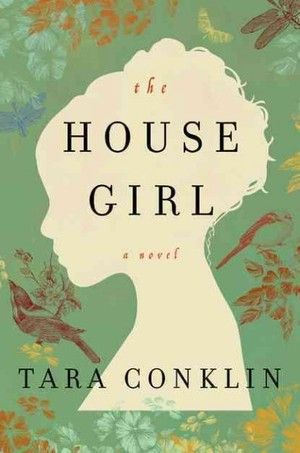
The House Girl by Tara Conklin


The House Girl was on the featured shelves at the front of the library and I picked it up based on both the cover and the title.  I was intrigued by the premise and I wanted to read something for Black History Month.  Even though I finished it about a month late, I'm still glad I read it.

The plot focused on the parallel lives of two very different women: Lina, a young lawyer at a white shoe law firm and Josephine, a house slave in Virginia.  Their stories intersect when a major client of Lina's law firm wants to start a reparations suit on behalf of the descendants of slaves (he estimates an unjust enrichment of nearly 7 trillion dollars based on slave labor) and needs a compelling lead plaintiff.  Lina's father, an artist just beginning to achieve commercial success and preparing for a show featuring images of Lina's dead mother, Grace, brings up a recent controversy regarding the authorship of the paintings of Lu Ann Bell, an iconic southern artist.  Scholars have started to question whether the paintings were made by Lu Ann or by her house slave, Josephine Bell.  Lina decides that a descendant of Josephine would be the perfect lead plaintiff for her case, but there are no records of Josephine after Lu Ann's death in 1852.  Lina begins her search and the reader learns more about Josephine's life and, of course, Lina's own life.

Overall, I enjoyed the book.  It was well-written and the structure was interesting.  It's divided into three sections, each with a different set of narrators.  Part one features Lina and Josephine; part two uses Lina, Josephine, and Dorthea, the sister of a well-known abolitionist and suffragette; and part three goes back to Lina, Josephine, and Caleb, a man who plays a small but significant part of the story.  Lina's story, obviously, is told from her own point of view.  Josephine's story, however, is told not only from her point of view, but also through articles and letters.  Overall, the book's structure reminds of A.S. Bryant's Possession.

Unsurprisingly, a book involving this subject matter is going to raise some interesting issues. First and foremost, not only was the book written by a white woman, but Lina, another white woman, was the driving force behind the story.  That's obviously problematic when the subject of a book is about slavery and a black woman's voice being silenced by a white woman.  Most of the other well-developed characters were white, including Dorthea, Caleb, and Jasper, a possible descendant of Josephine and a potential lead plaintiff (and potential love interest for Lina).  Dresser, the client behind the lawsuit, is black, but although he has strong personal convictions about suit, he's also only doing it because it's politically expedient.  Consider one of his quotes:
We would not be the world's superpower today if we had not had two hundred and fifty years of free, limitless labor on which to build our economy... What were their names, Dan?  They were our founding fathers and mothers just as much as the bewigged white men who laid the whip against their backs.  Isn't it time this country made the effort to remember them?

Then this one:

"I've gotten confidential confirmation that, after we file the suit, the government will issue a formal apology for slavery... We'll pull the government claim and then the feds will ut some pressure on our corporate defendants to settle... It's a nice distraction, you know, atone for the sins of the past, maybe divert attention away from the perceived sins of the present.  But it's the deep pockets we're concerned with here.  The government gets to look like the good guy, and we get some real weight behind us."

Since the book is set in 2004, one of the major "perceived sins of the present"  was, of course, Abu Ghraib.  So the only real person of color in the contemporary part of the story is not only not very fleshed out, but also at least a little amoral regarding the subject.  It also strikes me as a bit problematic that the potential face of the effects of slavery today was not only white (technically about 1/64th black), but had no idea that he had a black ancestor or that said ancestor was a slave.

As a white woman, I don't feel comfortable going too far into the racial issues, but I am comfortable discussing the gender issues.  Specifically, as with the race issue, this is also a story of women, but again, it's driven forward by men.  Not only that, but it seems to pit woman against woman a lot.  First, Lina is threatened by Meridith.  Here's the description of her:
  
[T]he six-foot blond litigation associate rumored to be dating a Yankees outfielder... Meridith sat ramrod straight in meetings, she spoke articulately, rationally, with apparent  interest [about a variety of subjects].  Lina saw her as a nemesis of sorts, an otherworldly being who provoked Lina's competitive streak as well as her annoyance.  (Meridith frequently forgot Lina's name.)
 Second, the issue of authorship of the paintings is presented as a zero-sum game.  Lu Ann Bell had been embraced "by modern feminists  as civil rights activists as a woman who, due to the constraints of the society in which she lived, expressed her beliefs in the only way she could: through her art."  It's important to remember that Lu Ann never took credit for Josephine's work.  In fact, since apparently neither Lu Ann nor Josephine signed their work, the authorship was only assumed.  Second, Lu Ann was an artist, but lacked Josephine's talent.  Regardless of her natural ability, though, her art was still an outlet.  Despite all of this, though, it's presented as an either/or situation.  If Josephine's authorship is acknowledge, then, as the archivist at former home of Lu Ann (and Josephine) said, Lu Ann (or at least the idea of her) will be "lost."

In both examples, there's the clear idea that the greatest threat to a woman is another woman.  In Lina's case, there's no particular reason given for her to see Meridith as a bigger threat than any other first year associate, but for some reason, she does.  In the case of Josephine and Lu Ann, there's the idea that only one of them can be given a voice and the other has to sink into the same voicelessness that countless other women have suffered.  It doesn't matter that both women have a story to tell and that story would, in turn, help provide a voice for other women in the same position.  Apparently, a woman has to earn the right to be heard and only the great artist gets a voice.  The other woman, the one who made mediocre art, sinks back into obscurity.

Finally, there's the issue of Josephine's child.  Her child's father was white.  More accurately, her  child's father was Lu Ann's husband, "Mister," and the child was the product of rape.  While this was examined more specifically in some of the information I came across while looking for some background information and while Conklin did explore this issue a bit and while she did examine the strain this placed on the relationship between Lu Ann and Josephine, the full horror of it wasn't explored.  Oddly enough, I feel that The Office did a better job addressing the problems of that issue.

I want to emphasize that I absolutely enjoyed the book and I think Conklin did a great job of exploring difficult subject matter.  In fact, the very fact that these issues occurred to me proves that Conklin wrote a thought-provoking book.  I think that most of my criticisms are more a product of society at large and even the greatest novel dealing with this subject matter is going to still have its shortcomings when it comes to examining issues of race and gender.  In fact, I feel like I'm completely ignoring some other important parts of the book, such as Lina's feelings toward her dead mother and how her father's art exhibition of portraits of her mother affects her not because they don't merit examination, but because there's so much to discuss.   Furthermore, I think that a lot of the more problematic aspects of the book are the most realistic, such as murky motivations for filing the suit, glossing over the implications of a white man being descended from a slave, and the adversarial relationship between women.  That said, I can't recommend this book enough.  Not only did it keep me engaged until the very end, once it was over, it made me think. 

Wednesday, November 30, 2011

The Believers by Janice Holt Giles

My mother is very interested in Kentucky history and literature. A couple of months ago, the local library hosted an event which featured an actress performing a monologue based on the life of Mary Settles, the last Shaker at the Pleasant Hill Village. Although I had visited Shakertown as a child and I remember owning a doll from there that had a smiling face on one end and a frown on the other end. It's hard to explain and I don't have the actual doll for a picture and I do not recommend doing a search for "Naughty nice doll" on Google images, because even with safe search on, I got some pretty weird hits.

I didn't know much about the Shakers before the dialogue. I knew that "Simple Gifts" and "How Can I Keep from Singing" were Shaker hymns, that they had sent aid to Ireland during the potato famine, and that their name came from movements in their worship services. The monologue was enlightening, since it told both the story of Mary Settles (who was abandoned by her husband at Shakertown) and the history of the Pleasant Hill village, as well as the overall history and beliefs. The monologue painted them in a very positive light, pointing out that they were very progressive on social issues like race relations and equality for women and that they also took in orphans. The Shakers required celibacy from their members and didn't allow private property for full members. In a nutshell, it was a very Utopian society that's lasted for a surprisingly long time. Mary Settles died in 1923 and was the last of the Kentucky Shakers, but there is still an active village in Maine with three members (and yes, there's a website.

I'm not going to go into Shaker history or beliefs very much, since I don't know enough to really discuss it and even if I did, there's so much to discuss. I recommend a little research, though, because it is fascinating and I plan to do more eventually.

The Believers gave a much less favorable view of the Shakers. It takes place in the late 1700's and early 1800's and is the story of Rebbecca Fowler who marries Richard Cooper, the son of her neighbors. Rebbecca and Richard had been friends since childhood and Richard's parents were slightly more prosperous than Rebbecca's family. Richard is a serious, devout, hard-working man and when they marry, his parents give them some of their property to build their house and start a farm, as well as two slaves, Sampson and Cassie, along with their daughter, Jency.

The first few months of their marriage are idyllic, but then their first child is stillborn, which is devastating to both of them. While trying to cope with his grief, Richard attends a revival and decides to follow one of the ministers to form a new settlement. As Rebbecca is getting used to this change, a few Shaker missionaries arrive and Richard decides to join the Shakers. Rebbecca, believing that her place is with her husband, follows him, albeit with misgivings.

The Believers takes a long, hard look at the realities of the Shaker environment. While most of the full members are very devout, they're nowhere near perfect. There is pride and ambition, as well as the difficulties that come with forcing a group of people to live in close quarters. The women in Rebbecca's "family" (actual families are separated and divided into church families, where the children are raised separately and the men and women are segregated) formed a fairly tight bond, but there was also significant conflict among the women. A lot of them chafed at various aspects of the religion. Giles did a wonderful job of showing the problems encountered when a large group of self-sufficient adults are suddenly forced into a highly disciplined environment.

The one problem I had with the book is that it was very much a product of its time. The slaves played a significant role in the book and Giles's treatment of them was probably progressive for when it was written (1957), but reading a book about an extremely racist time written in a very racist time... Well, I believe Giles did her best to portray the slaves positively, but the slaves, especially Jency, still came off an inferiors who needed someone to guide and care for them.

In spite of the problems, I enjoyed it. I also found out that The Believers is the third book in the series. I plan to read the rest of the series as well as doing more research on the Shakers. I'd also love to visit Shakertown over the holidays, since some of the events on their website look amazing.

Thursday, November 17, 2011

Alcestis by Katharine Beutner

I've been slacking off recently with reading and blogging. I'm not really sure whether it's a result of things being slightly more hectic than usual or the fact that I can't seem to get into the books I've been trying to read lately. Either way, here I am with a finished book.


Alcestis is a retelling of the play by Euripides with a feminist twist. In Greek mythology, Alcestis was married to King Admetus who offended Artemis by failing to sacrifice to her following the wedding. She filled Admetus's bed with snakes, but Apollo stepped in and allowed Admetus to avoid death if someone would volunteer to take his place. No one did, so Alcestis stepped forward. After that, Heracles rescued her from Hades and she and Admetus apparently lived happily ever after.

Despite having taken a classical literature course, I've never read the actual play. Like The Penelopiad, it really motivates me to go back and read more classical literature. In fact, one of my goals for 2012 (and one I may start early) is to dedicate some time to reading The Great Books of the Western World, since I recently discovered that my library has all of them. I also plan to work on a more comprehensive reading list to cover books that I should have read ages ago.

Anyway, I freely admit that I went into this novel at a disadvantage. I can't compare the novel to the original play, which is a shame since there seems to be a lot of interesting critique surrounding it.

What I can say is that I liked it. As expected, it was a pretty big deviation from the generally accepted views of Greek mythology. The male characters generally didn't fare favorably in the novel and were either undeveloped or definitely negative, ranging from abusive to cowardly to almost blundering. They absolutely weren't portrayed as heroic. I think there's something to the fact that the few "good" male characters are the ones who aren't really explored, which obviously makes you wonder if we just don't know enough about them to think poorly of them.

The women are fascinating, however. The story starts with the birth of Alcestis and the death of her mother. After that, she forms a close relationship with her older sister, Hippothoe and views her oldest sister, Pisidice, with confusion. Early on, Hippothoe dies due to her asthma and, more importantly, in Alcestis's view, Apollo's failure to intervene. Her search for Hippothoe in Hades becomes a driving force later in the book. After Hippothoe's death, Pisidice and Alcestis seem to reach an understanding, but their relationship is cut short when Pisidice marries. Pelias remarries and his wife, Philomache, plays a brief but important role until Alcestis is married.

After Alcestis' death, both Hades and Persephone play an important role, for different reasons. Persephone has always been, for me, someone who was just there and played a footnote in Greek mythology. Basically, "by the way, Hades kidnapped Persephone, Demeter got angry and caused winter, Zeus demanded she be returned, but she ate pomegranate seeds, so now we have seasons. The end, now let's move on to the important stuff," so it was really interesting to see how Beutner developed not only Persephone, but her relationship with Hades, her history, and her treatment of Alcestis.

I feel like I'm at a bit of a disadvantage for not having read the play and in hindsight, I wish I had. It would have given me more insight into what Beutner was doing with the characters. As it stands now, this is probably going to go on my "reread" list once I've really done a better study of Greek mythology.

Tuesday, August 30, 2011

The Tudor Secret by C.W. Gortner

I came across The Tudor Secret while I was browsing the library's new books. It's supposed to be a mystery set in Tudor England and since mysteries and historical fiction are two of my favorite lighter genres, I was intrigued.

The narrator is Brendan Prescott, a foundling taken in and raised in the household of the Duke of Northumberland. The most famous member of that family (or at least the only one that rang a bell for me) was his son, Robert Dudley, who was a longtime suitor of Elizabeth I. The Duke of Northumberland's youngest son, Guilford, was married to Jane Grey, the granddaughter of Henry VII's younger sister, Mary. Jane was (arguably) queen of England for nine days between the death of Edward VI and the accession of Mary I.

Brendan comes to court in the last days of Edward VI to serve as a squire to Guilford and is recruited by William Cecil to help advance the interests of Elizabeth. For his part, Brendan is interested in both helping Elizabeth, who he meets briefly on his first night at court when Robert sends him to deliver a ring, and discovering his origins.

Certain parts of the book were easy to anticipate, since it did fall back on predictable tropes. A young man with no family history taken in by a powerful family (even as a lowly servant) and educated beyond his apparent class by a caring guardian? There's definitely more to that story. There were also a few predictable sequences. And, of course, if you don't know how the plot to place Jane Grey on the throne ends, you evidently weren't paying attention in history class.

In spite of all that, though, Gortner does a pretty good job not being too predictable. Even though Brendan's parentage becomes partially obvious by chapter seven, the exact identity of his parents was a twist...one that isn't even resolved by the end of the book.

Gortner left a few things unresolved, though the ending definitely didn't feel incomplete or rushed. When I read in the interview at the end of the book that this was going to be the first in a series of novels with Brendan as a spy, I was excited to read more.

I'm a fan of Tudor books, though I generally prefer to read stories set in the reign of Henry VIII. The Other Boleyn Girl was probably the catalyst, though I don't particularly care her books because I feel that she generally vilifies certain characters to an exaggerated extent resulting in very two dimensional characters. To give Gortner credit, I didn't particularly see that in this novel...with a couple of possible exceptions, but even then, I feel like there was at least some groundwork laid and some historical basis.

The Tudor Secret is hardly heavy fiction and isn't the sort of novel that leaves you thinking after you finish it, but it was interesting and seems to be fairly well-researched. I would definitely recommend it to anyone who enjoys Tudor fiction and wants an interesting read.